Client reviews: how to collect more and how to answer bad ones
In short
- Ask for a review in the first hours after the visit — one short request with a link.
- Reply to every review, and always to bad ones: replies are read by future clients, not just the author.
- A good reply to criticism: thank them, acknowledge the specific point, offer a fix — no arguing, no excuses.
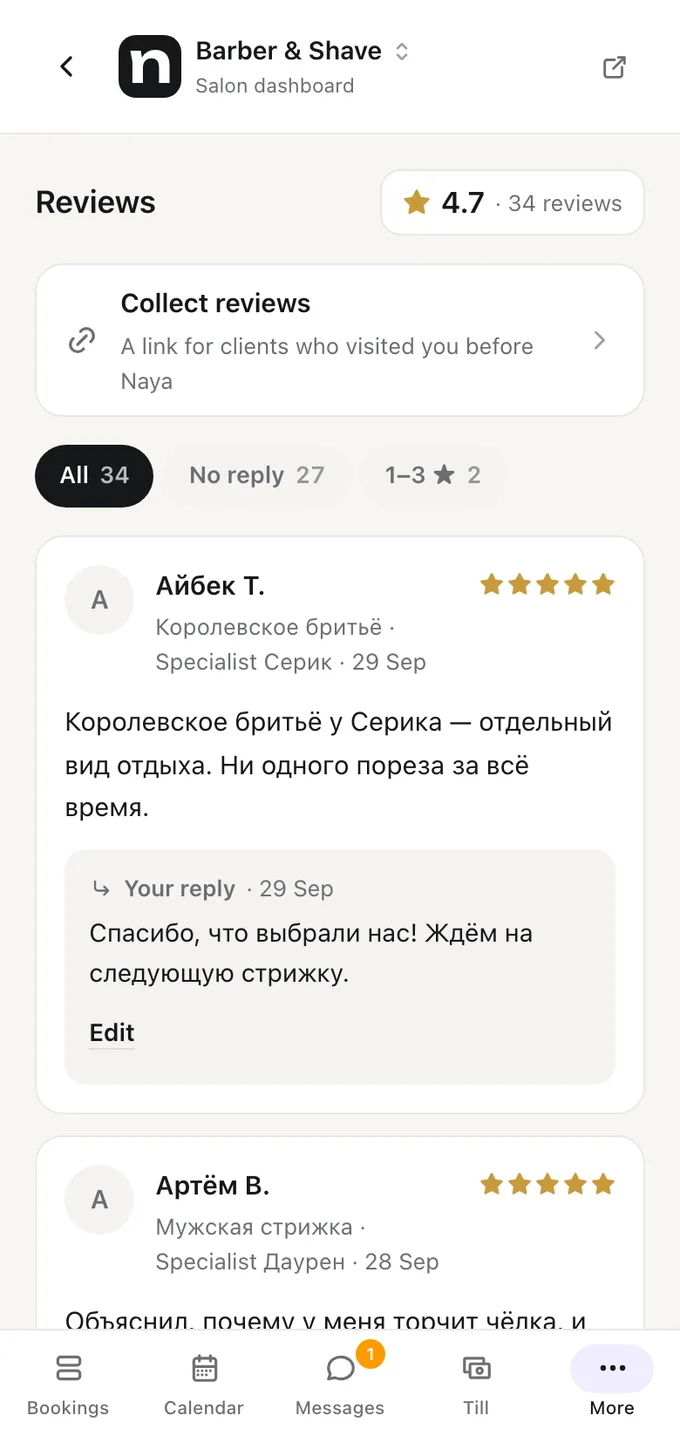
- Reviews from regulars who came before you had online booking can be collected too — with an invitation link.
A new client choosing between two specialists with similar work looks at the reviews. Not just the stars: how many there are, how recent, and how the specialist answers unhappy clients. But reviews don’t pile up on their own: a happy client needs a reason to write, while an unhappy one will find it themselves.
When to ask for a review
The best time is the first few hours after the visit, while the impression is fresh. A week later people don’t remember the details and don’t want to spend time on it.
- One request, not a series of reminders.
- A link that takes a couple of taps, with no sign-up on someone else’s site.
- No strings. “Leave five stars and get a discount” turns reviews into advertising, and readers can tell.
How to collect reviews from clients who came before online booking
A common situation: a specialist has hundreds of happy clients from years of work, and the new page has no reviews at all. Ask your regulars personally: a message to a specific person works better than a general post.
Example: “Hi! I now have a page for online booking. If you like my work, could you leave a review? It takes a minute: [link]. Thank you!”
How to reply to reviews
Replies are read not only by the author but by every future client. So it’s worth replying even to “all great, thanks!” — briefly and like a person, not with one copy-pasted line.
How to reply to a negative review
- Don’t reply straight away. Let the first reaction pass: a reply written in the heat of the moment is almost always worse than silence.
- Thank them and acknowledge the specific point. Not “we’re sorry you got that impression” but “you’re right, we kept you waiting twenty minutes”.
- Explain without excuses. What happened and what you changed.
- Offer a fix. Redo the work, refund, invite them back — and move the conversation to private messages.
- Don’t argue in public. Even if the client is wrong, others read the exchange and remember the tone, not the arguments.
| Instead of | Better |
|---|---|
| “You were fifteen minutes late yourself” | “Because of the late start we had to shorten the treatment — we understand you weren’t happy with the result. Let’s fix it at our expense — please message us” |
| “We’re sorry you got that impression” | “You’re right: the specialist didn’t tell you the price of the nail art in advance. We now give the price before starting work” |
| “This isn’t our client” | “We couldn’t find your booking — please message us so we can sort it out” |
What not to do with reviews
- Buy reviews or write them yourself. Sameness gives them away, and one exposed fake cancels out all the real ones.
- Promise a discount for five stars. Such reviews say nothing about the work — and readers understand that.
- Hide awkward reviews. A few honest four-star reviews with clear replies earn more trust than a perfect row of fives.
Frequently asked questions
How many reviews do I need for people to trust them?
There’s no magic number. It matters more that reviews are recent, varied and answered: a dozen genuine reviews from recent months convince better than a hundred old ones.
Can I ask for a review on WhatsApp?
Yes. The key is one short request with a link, no pressure and no promises in exchange for a rating.
What about a review from someone who was never a client?
Reply calmly that you couldn’t find their booking and offer to get in touch. If the review is false or abusive, report it to the platform — in Naya, just write to us.
Can I delete a bad review?
An honest one — no, and that’s in your interest: a page without a single criticism looks suspicious. What works is a reply that shows you listened and fixed things.
All of this is already in Naya
Online booking, client reminders, client cards and a till — in one dashboard for a salon or a specialist.