How to win back clients who stopped coming to your salon
In short
- A “lapsed” client is someone who hasn’t been in for a while and has nothing booked. The threshold depends on the service: a couple of months for a manicure, longer for colouring.
- First find these clients in your database, then think about why — and only then write.
- Write personally and with a reason: free time with their specialist, a new service, the question “was everything alright?”. No mass “20% off for everyone”.
- The cheapest move isn’t winning clients back but not losing them: book the next visit as they leave.
Almost nobody notices clients leaving: they don’t argue or write bad reviews — they simply don’t book again one day. Yet winning back someone who already knows you and your team is easier than persuading a stranger. To win them back, you first have to see who left.
Who counts as a lapsed client
A lapsed client is someone who has been to you but hasn’t come for a while and has nothing booked. “A while” depends on the service: a manicure every three to four weeks, a haircut every one to two months, colouring and cosmetology less often. If a regular manicure client hasn’t been in for two months, she’s most likely going somewhere else.
Why clients leave
- They moved or changed their routine. Hard to win back, and no need to.
- Something wasn’t right. More often than not, people don’t say so — they just don’t come back.
- They couldn’t book. No reply in time, no convenient slot, their specialist left.
- They forgot. They meant to book “next week” — and two months went by.
- They found somewhere cheaper or closer.
Some of these reasons can be fixed with a single message — if it’s sent at the right time and to the point.
What to write to a client who hasn’t been in for a while
The message should be personal and give a reason: free time, a new service or simply a question.
| Reason | Example message |
|---|---|
| Hasn’t been in a while | “Hi! We haven’t seen you for a while. Your specialist has free time on Thursday evening — shall we book you in?” |
| Might have had a bad experience | “Hi! We wanted to ask: was everything alright last time? If something wasn’t, please tell us — it matters to us” |
| Their specialist left | “Hi! Your specialist no longer works with us, but another specialist does the same service — see their work and free times: [link]” |
| A new service | “Hi! The hair treatment you asked about is now available. If you’re interested — here are the free times: [link]” |
What to avoid: a mass mailing like “20% off for everyone we haven’t seen in a while”. It teaches clients to wait for discounts, annoys people who simply changed their schedule, and promotional messages to phone numbers without people’s consent are a legal risk too.
How to stop losing clients
- Book the next visit as they leave. “Does the same time in four weeks work for you?” is the simplest way to keep a client.
- A reminder that arrives. A client booked in advance must get a reminder, or the booking turns into a no-show. More in the article on no-shows.
- Client notes. The colour formula, the favourite specialist, what they didn’t like last time: the next visit starts where the previous one ended.
- A question after the visit. An unhappy client who is asked often says what was wrong — and gives you a chance to fix it. How to ask for reviews — in a separate article.
How to tell it’s working
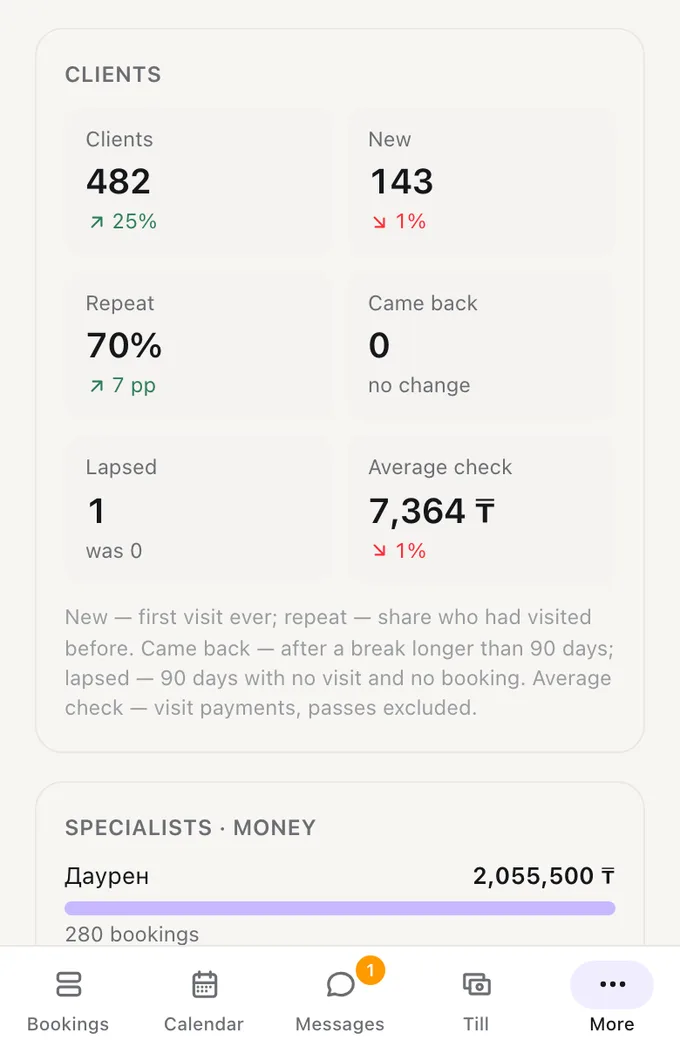
Once a month, look at two numbers: how many clients lapsed and how many came back. If fewer lapse and more come back, working with your client base pays off.
Frequently asked questions
After how long is a client considered lost?
It depends on the service: a rule of thumb is two or three of their usual intervals between visits. For a manicure that’s a couple of months, for colouring longer. In Naya’s statistics a client counts as lapsed after 90 days without a visit or a booking.
Can I message all my old clients at once?
Better one by one. A mass mailing annoys people and teaches them to wait for discounts, and promotional messages without consent are a legal risk too. A personal message with a reason works better.
What if a client replies that they didn’t like it?
Thank them for being honest, acknowledge the specific point and offer to put it right. A client who feels heard often comes back — and tells others about it.
Should I offer a discount to win a client back?
You can — individually and once, to someone who left after a bad experience. A discount “for everyone we haven’t seen in a while” devalues your prices for those who would have come back anyway.
All of this is already in Naya
Online booking, client reminders, client cards and a till — in one dashboard for a salon or a specialist.