Commission for beauty specialists: how to work out pay in a salon
In short
- There are three schemes: commission on revenue, a base wage plus commission, and chair rental, where the specialist works for themselves.
- The key question isn’t “what percentage” but “of what”: all revenue or revenue after materials. With the same number the difference is tens of thousands of tenge a month.
- It’s fairer to calculate commission on what the client actually paid, not on the price list: then discounts and refunds are shared by specialist and salon alike.
- Write the agreement down: commission by category, who pays for materials, what happens with no-shows and passes, and when pay day is.
“What commission should I pay?” is one of the first questions a new salon owner asks. There is no ready-made number: it depends on who pays for materials, who brings in the clients and what rent and reception cost. But you can work it out so the specialist is treated fairly and the salon still has enough to live on.
What pay schemes are there for specialists
| Scheme | How it works | Who it suits |
|---|---|---|
| Commission on revenue | The specialist gets a share of every paid service | When the specialist’s income should grow with their workload |
| Base wage + commission | A fixed part for shifts plus a commission on top | New specialists without their own clients, and salons that need guaranteed shifts |
| Chair rental | The specialist pays the salon for a chair or a room and works for themselves | Experienced specialists with regular clients |
Commission is convenient because the cost of the specialist follows revenue: in a quiet month the salon pays less, in a busy one the specialist earns more. Below is how to make commission clear for both sides.
What to calculate commission on
The most common reason for disputes isn’t the number but the base. “40%” of all revenue and “40%” after materials are different money. Try it with your own numbers:
What the specialist earns and what the salon keeps
Put in your own numbers — they are not sent anywhere. Rent, reception and taxes are not included: the salon pays them from its share.
The second fork is price list versus money. If a client got a 20% discount, does the specialist get commission on what was paid or on the full price? Paid is fairer and simpler: then the discount is shared by specialist and salon in their proportions. If the salon wants discounts not to hit the specialist, agree on that separately.
Why commission can differ between services
Services differ in materials and difficulty. A haircut uses almost no materials, colouring uses a lot; a manicure with nail art takes more time and skill than removing polish. So commission is often set by category: higher where the specialist puts in time and expertise, lower where much of the price goes on expensive materials.
Who pays for materials
- Salon’s materials. Lower commission, but the salon controls quality and usage.
- Specialist’s materials. Higher commission, and the specialist chooses what to work with.
- Mixed. Basic materials are the salon’s, premium ones the specialist brings, and commission on those services is agreed separately.
Any option works if it’s written down. Trouble starts when “materials on the salon” was assumed, the specialist brought their own and a month later expects to be paid back.
Passes, no-shows and group classes
When a client pays for a package in advance, the money arrives before the work. Usually the specialist is credited with a share of the price of one visit when the visit takes place. A no-show on a pass is a separate agreement: the visit is used up and the salon has the money — should the specialist who held the time be paid?
How to keep the payroll sheet error-free
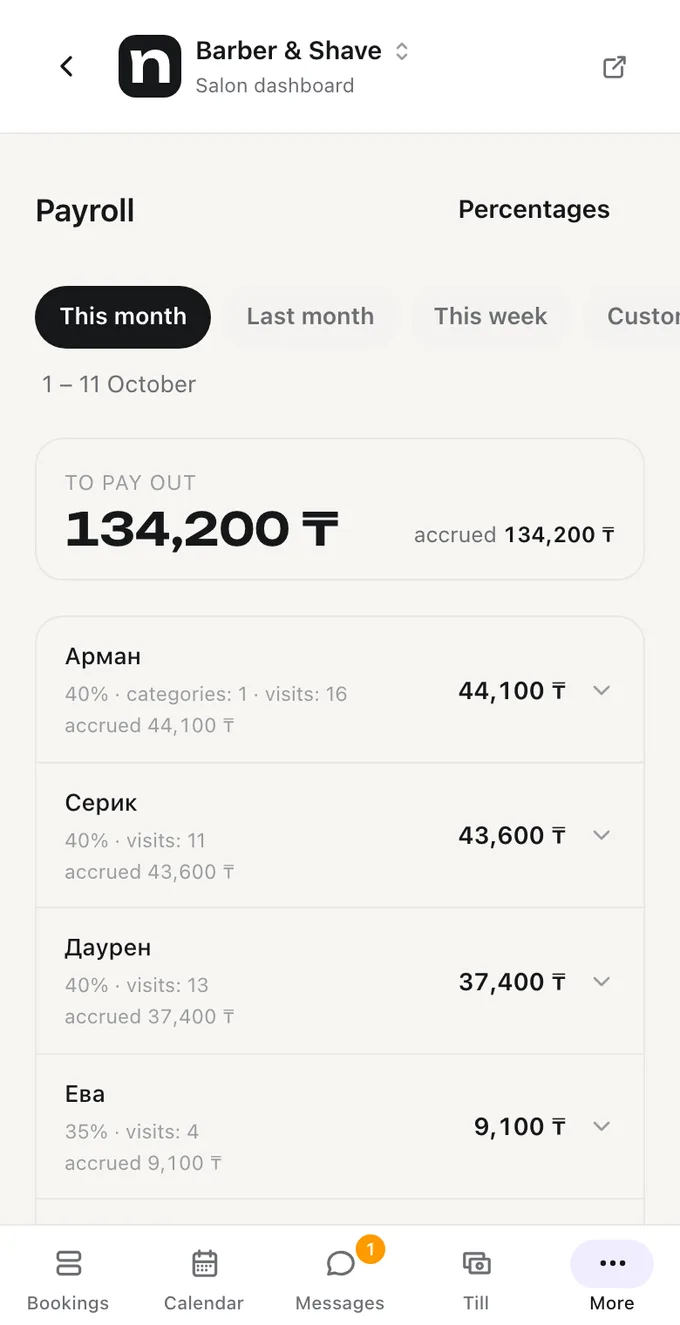
- Record payment right after the visit — then the calculation comes from bookings, not memory.
- Bonuses, deductions and corrections go in as a separate line with a reason, not as an after-the-fact edit.
- Record payouts too: the balance due is accrued minus paid out.
- Let the specialist see their own figures: when it’s clear what was accrued for, there are fewer disputes.
What to put in the agreement with a specialist
- The percentage and what it’s calculated on.
- Separate percentages by service category, if any.
- Who pays for materials.
- How discounts, refunds, no-shows and passes are handled.
- When pay day is: weekly, twice a month or monthly.
How to formalise the relationship — an employment contract, a contract with a self-employed specialist (IE) or rental — is a decision with tax consequences. Discuss it with an accountant before the specialist’s first shift.
Frequently asked questions
What commission does a salon specialist usually get?
There is no single norm: commission depends on who pays for materials, who brings in clients and what the salon spends on rent and reception. Use the calculator to see what the salon keeps at different numbers and compare that with your fixed costs — that shows what commission you can afford.
Should commission be based on the price list or on payment?
On payment: then the specialist’s share and the salon’s share change equally when a client gets a discount or a refund. You can use the price list, but then discounts fall entirely on the salon.
Should a specialist be paid when a client doesn’t show up?
If the client didn’t come and paid nothing, there’s nothing to calculate from. If the visit was prepaid or taken off a pass, it’s reasonable to credit the specialist’s share: they held that time.
What’s better for a specialist — commission or chair rental?
Rental pays off with a steady client base and a full diary: the payment is fixed and everything else is theirs. Commission is safer while clients are few: in a quiet month the specialist owes the salon nothing.
All of this is already in Naya
Online booking, client reminders, client cards and a till — in one dashboard for a salon or a specialist.